The console
Maneuver.Map is where our experiments are launched, recorded and replayed. Everything below is a screenshot of the console rendering a captured run — positions, links and windows come from the simulation’s own output, not from an artist’s impression.
A narrated walkthrough, including the orbital scheduling comparison, is available on request ahead of publication. Get in touch →
The constellation, and who can talk to whom
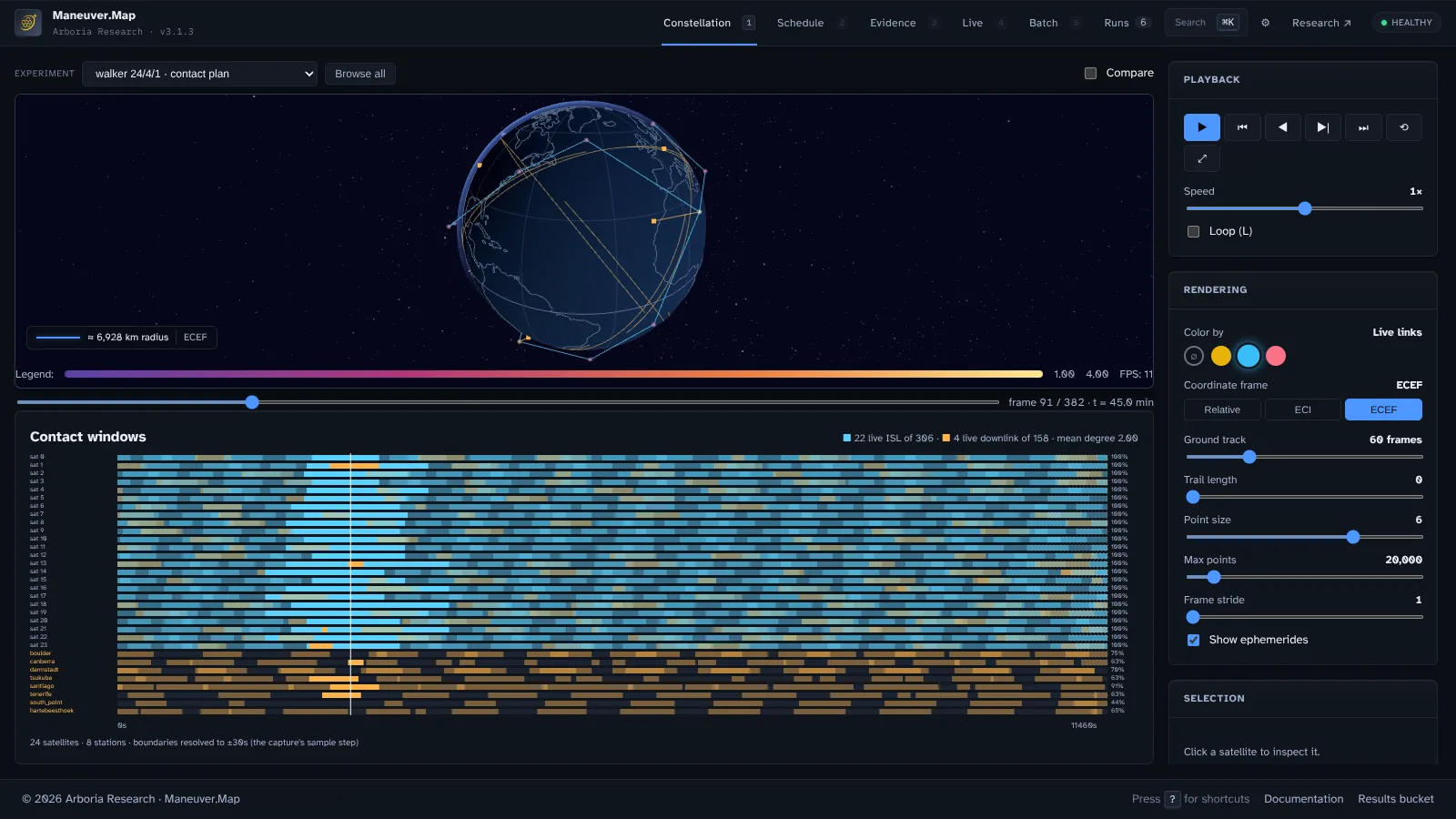
A Walker 24/4/1 constellation at 550 km with 5,000 km optical inter-satellite links and eight ground stations, drawn in the Earth-fixed frame. Blue lines are links that are open at this instant; amber lines are passes over a ground station. Below the globe, every contact window over two orbits — the gaps are where a message has to wait.
The link layer is captured, never re-derived in the viewer: the contact plan is computed once by Orrery on the same time grid as the positions, so a link is never drawn between satellites that are not where the plan thinks they are.
The schedule: delay is waiting
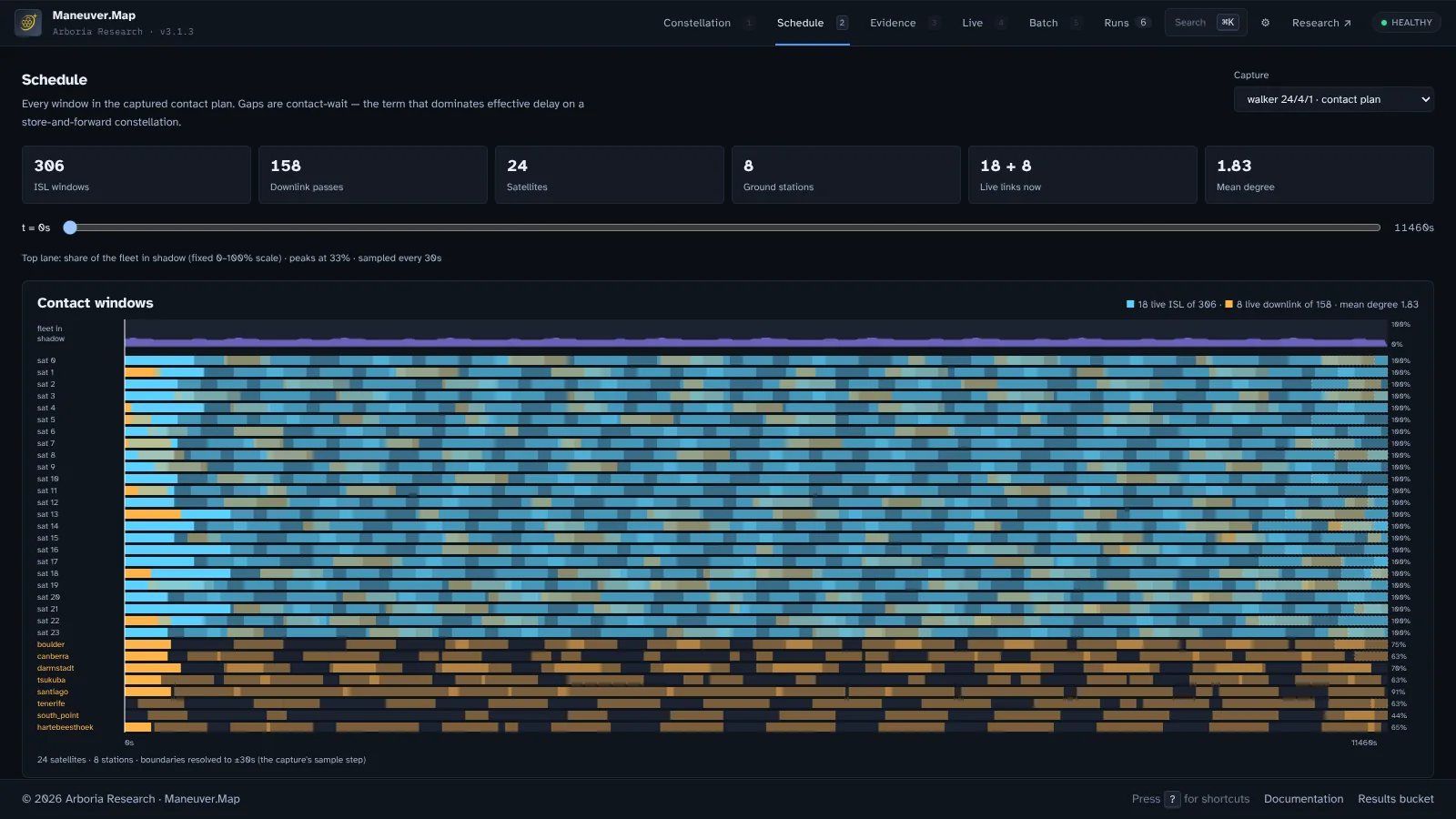
The same plan as a schedule. The top lane is the share of the fleet in eclipse on a fixed 0–100% scale; each row beneath is one satellite or ground station. On a constellation like this one, more than 99.7% of a message’s end-to-end delay is time spent waiting for the next window — which is why our coordination research is about staleness, not bandwidth. Window boundaries are resolved to the plan’s 30-second sample step, and the console says so on screen.
The engine, live in the browser
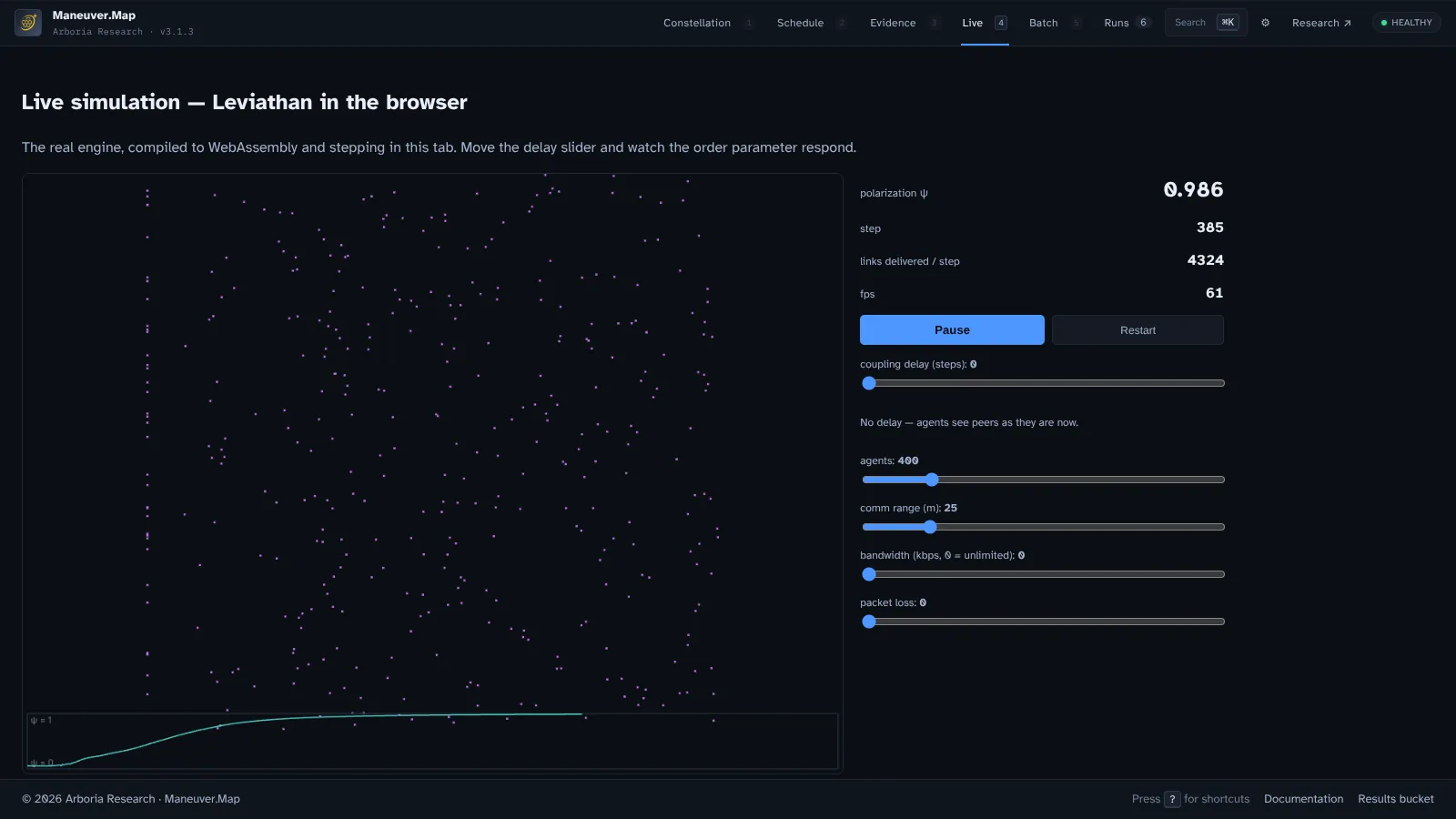
Leviathan, our C++ simulation core, compiled to WebAssembly and stepping in the page — bit-identical to the native build on noiseless runs. Raise the communication delay and the flock’s order collapses between roughly 15 and 20 steps: the same band where our delay papers find coordination failing. This page is a mechanism demonstration, not a published figure — its policy and order parameter differ from the papers’, and it says so on screen.
What the console refuses to do
The parts of the console we are proudest of are the ones that stop a plausible picture from being a wrong one:
- Absent is not zero. A satellite missing from a frame is drawn as a gap, an uncaptured cell reads ”—”, and a channel the run never recorded cannot be selected.
- One scale for a comparison. Two runs side by side share a colour scale and a y-axis; bounded quantities such as state of charge are drawn on their physical scale rather than stretched to whatever a frame happens to hold.
- Provenance travels with the picture. Comparisons are grouped by the benchmark’s specification digest, and a comparison that varies more than one thing at once is labelled confounded, not presented as a control.