Delay Relative to What? The Coordination Cliff Scales with the Task Timescale
Decentralized coordination collapses when communication delay grows — but “grows relative to what?” A companion study fixed the yardstick to the swarm’s own convergence time. Here we impose an external task timescale and show the collapse boundary tracks it directly, until the swarm’s intrinsic timescale takes over.
Chris Adams
Arboria Labs, Alpharetta, GA United States
Corresponding Author email: cadams@arborialabs.com
Abstract
Decentralized coordination collapses past a communication-delay threshold, but a threshold in steps is only meaningful relative to a timescale. A companion phase-diagram study located the collapse and, by varying the coordination gain, tied it to the swarm’s intrinsic convergence time. That leaves the complementary question: if we impose an external task timescale , does the boundary move with it? We build a delay-coupled tracking task in a simplified 3-D kinematic simulator in which a goal jumps once every and only a informed minority observes it — the remaining must acquire it through the delayed peer graph — and sweep s against one-way delay steps for gossip-consensus and flocking. The collapse delay grows with : in the regime where the task is the binding timescale (– s) the ratio is constant, so the cliff is governed by delay relative to the task timescale. For large ( s) saturates at steps — the swarm’s own convergence time becomes the shorter, binding timescale and the intrinsic cliff of the companion study reappears. A no-communication reference sits at the floor for every and delay, and a fully-informed control ( observers) is delay-insensitive: the cliff is present only when coordination must flow through the delayed graph, confirming it is a coordination effect rather than a tracking artifact. Together with the intrinsic-timescale result, this pins the boundary to . We scope the claim precisely: a simulation-based algorithmic result about coordination primitives under delay, not physical-device validation.
Keywords
Decentralized Coordination, Communication Delay, Task Timescale, Delay-Coupled Systems, Tracking, Consensus, Rendezvous, Multi-Agent Systems
1. Introduction
1.1. Background and Motivation. A delay threshold measured in integration steps is not, by itself, a physical statement — twenty steps is catastrophic for a task that changes every ten and irrelevant for one that changes every thousand. The meaningful quantity is the ratio of delay to some coordination timescale. A companion phase-diagram study [1] established the collapse and, by sweeping the coordination gain, showed the boundary scales with the swarm’s intrinsic convergence time (onset ). But a swarm coordinating on a real task also faces an external clock: how fast the objective itself moves. This paper imposes that external timescale and asks whether it, too, sets the cliff.
1.2. Problem Statement. We ask: if a coordination task is forced to change on a timescale , does the delay at which coordination collapses scale with ? And how does an imposed external timescale interact with the swarm’s intrinsic one?
1.3. Contributions.
- A delay-coupled tracking task with an explicit imposed timescale: a goal that jumps once per , observed by only a informed minority, so the majority must acquire it through the delayed peer graph — making sensitive to delay by construction (§3).
- A falsification control: a fully-informed variant ( observers) that removes the coordination requirement, and a no-communication reference, both run on the same grid (§3.3, §5.1).
- The imposed-timescale ratio law: scales with at while the task is the binding timescale, then saturates at the intrinsic cliff for large (§5.2, §5.3).
- A two-timescale synthesis with [1]: the boundary is set by (§6).
1.4. Outline. §2 relates this to tracking-consensus and delay-coupled dynamics. §3 defines the task, controls, and metric. §4 gives the setup. §5 presents the falsification control and the ratio law. §6 discusses the two-timescale synthesis and scope. §7 concludes.
2. Related Work / Background
2.1. Tracking and dynamic consensus. Dynamic average-consensus and distributed tracking [2, 3] follow a time-varying reference across a network; performance is known to depend on how fast the reference moves relative to the network’s mixing rate, and delay degrades tracking more than it degrades static consensus. We turn this into a controlled two-axis measurement: reference timescale against delay, with the reference visible only to a minority so acquisition is necessarily a coordination problem.
2.2. Delay-coupled coordination and the intrinsic timescale. The companion study [1] maps the delay cliff and shows it scales with the swarm’s intrinsic convergence time (via the coordination gain), with all curves collapsing onto a gain-independent master curve past onset. The present work supplies the second half of the ratio argument by imposing an external timescale; the two together identify which timescale binds.
2.3. Why an inert knob motivates this study. On the static rendezvous/consensus tasks of [1], the environment’s nominal timescale parameter never enters the quality metric — those objectives score the swarm’s own compactness, which no external clock moves. A genuine imposed timescale therefore requires a task whose target moves on ; the tracking task here is built precisely so that is causally active, not decorative.
3. Method
3.1. Delay-coupled tracking task. A single goal point is placed in the domain and re-drawn once every seconds. An informed fraction of agents observes the goal directly; the remaining observe only their peers, through the delay-coupled view. The coordination quality is a tracking-rendezvous score : high when the swarm is both compact and centered on the current goal. Because of agents can only reach the goal by following informed peers through the delayed graph, depends on delay through the coordination pathway — and on through how often the target invalidates the swarm’s acquired estimate.
3.2. Delay coupling and primitives. Delay is imposed exactly as in [1]: the primitive acts on the true peer snapshot from steps ago while each agent’s physics advances on true state, actuation re-referenced to true current velocity. Two primitives run behind the act interface: gossip-consensus and flocking, each steering informed agents toward the goal and uninformed agents toward their (delayed) neighborhood.
3.3. Controls. Two references isolate the coordination effect. No-comm — agents use no peer information; the uninformed can never acquire a goal they cannot see, pinning the floor. Fully-informed control () — every agent sees the goal directly, so the task needs no coordination-through-delay; if the cliff were a tracking artifact rather than a coordination effect, it would persist here.
4. Experimental Setup
Runs use Gossamer (v0.6.0) primitives through Maneuver.Map’s vectorized policy seam, on the Leviathan engine (velocity-Verlet integrator). Energy and fault modules are disabled (, ). The main grid is primitive delay seed cells; primitives gossip, flocking, no-comm, s, delay steps (), , informed fraction , seeds 1–5. A separate control grid (-fixed) sweeps informed fraction delay seed cells. Every reported point is a mean over seeds.
5. Results
5.1. Falsification control: the cliff needs the delayed graph. Table 1 is the gate. With the goal fully observable () the tracking score is delay-insensitive — gossip holds at delay and at delay , a gentle droop, because each agent simply steers to a goal it can see. With only the informed minority (), the same primitive collapses — at delay falling to at delay — because the uninformed majority must relay the goal through the delayed peer graph. The delay cliff appears only when coordination must flow through the delay; it is a coordination effect, not a tracking artifact. (That starts below even at delay is expected: acquiring a jumping goal with a seed is hard before delay is added.)
Table 1. Falsification control: tracking quality (gossip) versus one-way delay (steps) at two informed fractions, fixed, , mean over 5 seeds. From the dcc_p4b_control batch. Full observation is delay-insensitive; partial observation collapses.
| Informed fraction | |||||
|---|---|---|---|---|---|
| 1.00 (fully informed) | 0.92 | 0.91 | 0.91 | 0.92 | 0.84 |
| 0.15 (partial) | 0.47 | 0.38 | 0.28 | 0.15 | 0.04 |
5.2. The cliff shifts with the task timescale. Fig. 1 (left) sweeps on the partially-informed task. As the goal is held steady longer, the swarm tolerates more delay before collapsing: the cliff moves rightward with . The no-comm reference sits at the floor (–) for every and delay — the falsification floor of §5.1, confirming the informed fraction is low enough that coordination is genuinely required. At the shortest timescales the task outruns coordination entirely: at s the swarm never reaches even at zero delay, because the goal jumps faster than the swarm can gather onto it.
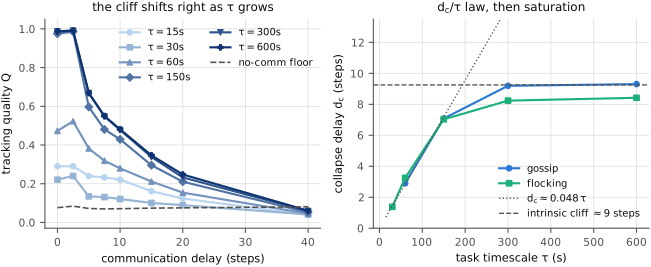
5.3. The ratio law, and where it saturates. Fig. 1 (right) and Table 2 quantify the shift. Defining the collapse delay as the delay at which crosses , grows with , and in the task-binding band (– s) the ratio is constant across both primitives: the cliff is governed by delay relative to the task timescale. Above s the ratio breaks and saturates near steps (gossip) / steps (flocking): once the task changes slowly enough, it is no longer the binding timescale — the swarm’s own convergence time is — and the boundary reverts to the intrinsic cliff of [1], independent of how much slower the task becomes.
Table 2. Collapse delay ( crossing, integration steps) versus task timescale , for gossip and flocking, , mean over 5 seeds. From the committed dcc_p4b records. Dashes mark timescales too fast for the swarm to reach at any delay. The ratio is constant in the task-binding band and falls as saturates.
| (s) | gossip | gossip | flocking | flocking | binding timescale |
|---|---|---|---|---|---|
| 15 | — | — | — | — | task (too fast to gather) |
| 30 | — | — | 1.4 | 0.046 | task |
| 60 | 2.9 | 0.048 | 3.2 | 0.054 | task |
| 150 | 7.1 | 0.047 | 7.0 | 0.047 | task |
| 300 | 9.2 | 0.031 | 8.2 | 0.027 | intrinsic (saturating) |
| 600 | 9.3 | 0.016 | 8.4 | 0.014 | intrinsic (saturated) |
An interactive version of the figure (hover for per-point values) is available as a companion artifact.
6. Discussion, Scope, and Limitations
Two timescales, one cliff. This paper and its companion [1] measure the same boundary against two different clocks. [1] fixes the task and varies the swarm’s intrinsic convergence time (via gain), finding onset . This work fixes the swarm and varies the task timescale, finding — until the two timescales cross. The saturation at large is the signature of that crossing: the binding constraint is whichever timescale is shorter, so the collapse boundary is set by . A designer reads this directly: coordination survives delay only while that delay is small compared to both how fast the objective moves and how fast the swarm can re-converge.
Scope. This is a simulation-based algorithmic result in a simplified 3-D kinematic engine, not physical-device validation. Three limits. (i) One informed fraction on the main grid: is chosen low enough that no-comm stays at the floor (§5.1); the -dependence of itself (a third axis) is left to the control grid and future work. (ii) Crossover resolution: the delay grid brackets the crossing but is coarse near the saturation knee; a densified grid there (as in the intrinsic-timescale refinement of [1]) would sharpen the exact crossover . (iii) Task family: the imposed timescale is a jumping-goal tracking task; other time-varying objectives (drift, periodic motion) may shape the pre-collapse curve differently even if the boundary law holds.
7. Conclusion
Imposing an external task timescale on a delay-coupled swarm, the delay at which coordination collapses scales with that timescale () while the task is the binding clock, then saturates at the swarm’s intrinsic cliff once the task changes slowly enough. A no-communication floor and a fully-informed control confirm the boundary is a coordination-through-delay effect, not a tracking artifact. With the companion intrinsic-timescale result, the delay cliff is pinned to the ratio of delay to the shorter of the task and intrinsic timescales — a single, two-sided ratio law for when decentralized coordination survives communication delay.
Data and Code Availability
All §5 numbers and Fig. 1 regenerate from the committed dcc_p4b experiment records (720 cells) and the dcc_p4b_control batch (80 cells), 5 seeds each, via Maneuver.Map’s analysis path — aggregating task_metrics.Q_final over seeds by (algorithm, tau_sec, delay) for the main grid and (informed_frac, delay) for the control. The tracking task, delay-coupled harness, and primitives are those of the companion phase-diagram study [1]. The pinned wheel and base-image identity, batch ids, and seed tree are in Appendix B; the lab’s disclosure policy is at Reproducibility and Data Availability.
References
[1] Adams, C., “Phase Diagram of Decentralized Coordination Under Communication Delay,” Arboria Labs, 2026. /research/phase_diagram_coordination_communication_delay [2] Zhu, M., Martínez, S., “Discrete-Time Dynamic Average Consensus,” Automatica, 2010. [3] Kia, S. S., Van Scoy, B., Cortés, J., Freeman, R. A., Lynch, K. M., Martínez, S., “Tutorial on Dynamic Average Consensus,” IEEE Control Systems Magazine, 2019.
Appendix / Supplementary Material
Appendix A: Why the ratio law saturates. Two timescales compete: the task timescale (how often the goal invalidates the swarm’s estimate) and the intrinsic convergence time (how fast the swarm re-gathers, set by gain/speed/radius as in [1]). Coordination survives delay while is small relative to the binding timescale. When the task binds and (the measured band). When the intrinsic timescale binds and const (the saturation), matching the intrinsic cliff of [1]. The crossover is where leaves the line for the -step plateau — here between and s.
Appendix B: Reproducibility checklist.
Canonical batches. Main grid dcc_p4b-20260710T233740-c926ca7c (720 cells); falsification control dcc_p4b_control-20260710T195844-927907d4 (80 cells).
The grids. Main: primitive gossip, flocking, no_comm s delay steps seeds 1–5, informed fraction , task tracking_rendezvous, . Control: delay seeds 1–5.
Fixed parameters. dt=1.0, bound=1000, init_spread=500, comm_range=1200, energy_rate=0, fault_prob=0, integrator=velocity_verlet, steps=1500.
Environment. Gossamer 0.6.0; Python 3.10.12 on Linux x86_64 (glibc 2.35), numpy 2.2.6, scipy 1.15.3, pandas 2.3.3, pyarrow 25.0.0; environment lockfile hash 4de1e199…. Each cell’s experiment.json records package versions, the lockfile hash, a hardware fingerprint, and the full seed tree; figures regenerate by aggregating task_metrics.Q_final over seeds.
Appendix C: Unified symbols. (coordination quality), (delay in steps), (imposed task timescale), (intrinsic convergence time), (informed fraction) follow the shared conventions in the unified symbols table.
The intrinsic-timescale companion is Phase Diagram of Decentralized Coordination Under Communication Delay.