Coordination for orbital compute
Compute is moving to orbit for uninterrupted sunlight and radiative cooling. A constellation of compute nodes has a problem a data centre on the ground never has: its nodes cannot all talk at once. Links open and close as satellites move, power comes and goes with eclipse, and every decision is made on information that is already old.
Arboria Labs measures what that does to coordination — and builds the tools to engineer around it: a digital twin of the constellation, an open benchmark, and decentralized scheduling that does not need a central planner. Every number we publish names the experiment that produced it.
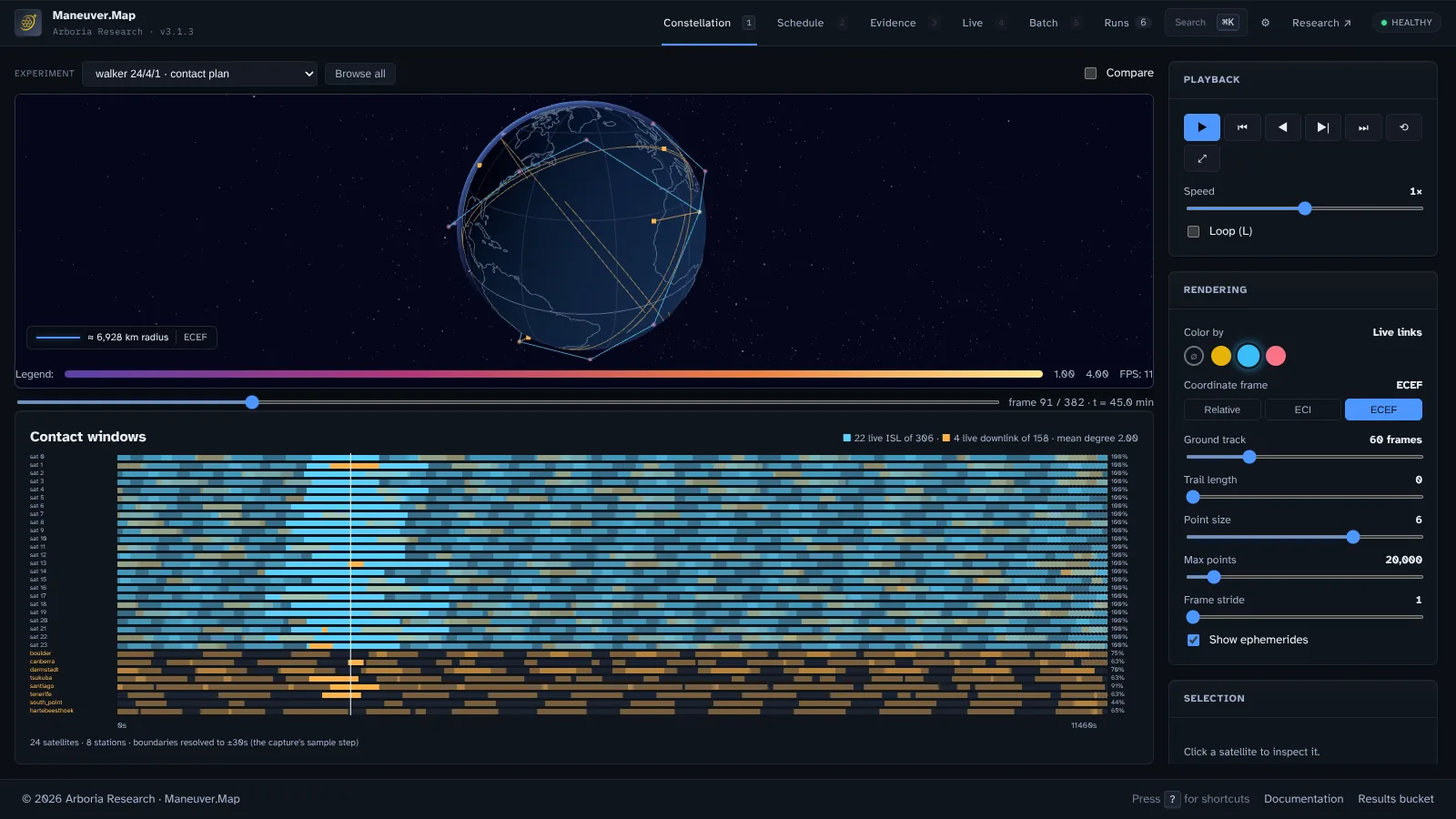
A Walker 24/4/1 constellation in our console: live inter-satellite links (blue), ground passes (amber), and every contact window over two orbits. Rendered from a captured contact plan, not an illustration. See the console →
What we build
- Orrery — the twin. Orbits, inter-satellite visibility, eclipse and power, ground passes, and the delay oracle: how long a message actually takes to cross the constellation, decomposed into flight time and waiting time. Validated against external references — the sun-synchronous inclination, the ISS’s nodal regression, a real ISS orbit from its published elements — not against itself.
- The Arboria benchmarks — versioned swarm and constellation tasks where every result names the exact frozen environment it ran on, and where a degenerate row or a fault that never fired fails the run instead of reading as robustness.
- Gossamer and Leviathan — the coordination algorithms and the physics-and-channel engine underneath, including energy-aware scheduling for compute constellations. Maneuver.Map orchestrates experiments, records provenance, and replays them in the browser.
What we have measured
These are simulation results about coordination algorithms, scoped to the fidelity of the model behind them. They are not flight or hardware validation. See Reproducibility.
- Coordination has a delay cliff. Decentralized coordination quality collapses through a narrow band of communication delay — 10–20 steps in our studies — identically across gossip, flocking and intent-propagation primitives and at 500 or 2,000 agents. The phase diagram →
- Cheap prediction moves it. Extrapolating each peer’s last known state recovers much of the lost coordination past the cliff. Anticipatory coordination →
- Freshness matters; throughput does not. Cutting delivered messages fifty-fold barely moves coordination; making them older collapses it. Freshness vs throughput →
- In orbit, delay is waiting. On a Walker constellation with 5,000 km optical links, more than 99.7% of end-to-end delay is waiting for the next contact window rather than light travel — which puts constellations past the cliff above. Why →
- Markets are regime-conditional. On a terrestrial construction task an auction beats first-come-first-served only under scarcity — and loses when over-provisioned. We published that correction against our own earlier headline. The market paper →
Orbital results on scheduling, intent routing, formation safety and radiation are written up and will be published as they clear review. How this relates to Starcloud, Suncatcher, NASA Starling and open spacecraft simulators →
How the stack fits together
Our Research Ethics
Autonomous collectives have a specific set of risks that are not addressed by generic AI ethics. We take them seriously:
Dual-use caution. Swarm methods can be used for surveillance, denial, and coercion. We do not contribute directly to lethal autonomous weapons and we gate publications that could materially accelerate them.
Orbital and planetary responsibility. Large deployments in space create Kessler-syndrome risk and planetary contamination risk. Our simulations and recommendations treat debris, deorbit, and forward-contamination as first-order constraints.
Reproducibility over spectacle. Every published result names the batch it came from and records the environment that produced it. Our engines are proprietary, which limits what external reproduction can mean; we say so plainly rather than promising more than we can deliver. See Reproducibility and Data Availability.
Careful claims. Our results come from a simplified kinematic simulator. They are claims about coordination algorithms, not validation of physical devices, and we scope them to the fidelity that backs them — anchoring against known external results wherever we can.
Learn more about our principles →
Latest Updates
Releases, research notes, and corrections — including the ones that went against us.
Arboria Labs: coordination research for constellations that cannot all talk at once — measurement-first.